The Math Tutor for Small Group Tuition for PSLE, GCE O level IGCSE IB Diploma IP Programme Additional Maths for Primary and Secondary Levels. Top Singapore Tutor with two decades in education.
English Language tuition in Singapore has gone a long way since our independence and this can be attributed to three main components of increased business opportunity, parent’s desire for their children to be job competitive and the government’s push to be glocal.
English Language in Singapore
Thinking glocal is how we can be successful in a nation that takes pride in being the centre of the world. We are the avenues between the East and West, and our geopolitically advantageous positioning has put our small island onto centre stage of the international market by providing professional, competitive, stylish and efficient flow of air/sea traffic, a robust financial market, plus a hardworking and talented workforce that has adopted the English Language as their lingua franca.
The English Language, with 1 500 million speakers, of whom only 375 million are native (statistica.com), are the highest adopted language in the world. This is seconded by Chinese Language with 1 100 million speakers but are predominantly native speakers of 982 million. With the rest of the languages tailing far behind these two.
The dominance of these two languages means that commanding a mastery in either of the language lets you talk to 1 in every 5 or 6 persons living on earth. In Singapore, the Chinese population that learns Chinese as their second language (and English as a First Language) in school drives these statistics to 1 in every 2.7 person on earth. And that is a lot of people that bilingual English/Chinese speaking Singaporeans can converse with. Coverage is key to a successful business plan and if a business entity can serve a wider network, that unhinges latent opportunities and make connections with markets that would have been otherwise foregone.
This is an advantage that keeps us relevant. The ability to communicate with almost half of the world means we can do business with any country, help anyone in times of need, but more importantly, be a friend with everybody. It is where we become truly global, not only by going out and making friends, but to be a welcoming host and the world comes to you.
Inculcating English into Singaporeans started with our education systems 50 years ago. Compulsory English examination passes to advance, with every subject in school taught in English (minus ethnic languages) means mastery would be advantageous in learning fast and an ability to grasp complex technical concepts. That universities are lectured in English as well, attainment of a degree, a professional career and ultimately, survival, hinges on the proficiency of English.
But that is a 20th century strategy: language assimilation.
Latest generations of 21st century English-speaking Singaporeans pass on their English to their children as if the equivalent, a native speaker. English-educated Singaporeans now speak, read, write English as their first language and their children don’t need to learn “A” for Apples in Primary 1 like 40 years ago.
Our children is born into an English speaking household and vernacular to English. We have evolved and our children have become as native an English user as any other.
Our diverse ethnicity and international positioning keeps English relevant to our lives. Over generations, the English Languge has proven to be a viable marriage into our culture, keeping our traditions whilst adopting Western cultures and views that helps rather than deter. The ability to communicate with most of the world keeps us competitive and economically viable.
“The Limits of my language is The Limits of my World”-Ludwig Wittgenstein
It makes us globally active, engaging, dynamic and yet keeps us intimately connected with our immediate neighbors. Making friends where it would have been near impossible in our multi-cultural nation. Thinking glocal helps when our nation support such diverse ethnic groups where finding a common language would mean learning 4-5 languages just to talk to our neighbours. English breaks down barriers and carries our thoughts. To understand, first, we need to convey in a common language.
So where next for English in Singapore? We will continue evolving. Our primary education system for English Language just got tweaked this year after 4 years of research into what we need to improve in our education. There is a push to change from the government sector to include creative aspects into our system.
There is also a sudden increase in international awareness that Singapore is a global city, thanks to Marina Bay Sands and the yearly Formula 1 events. One can’t be hospitable unless one communicates and understands hospitality.
And what about English as an art form? Literature, poetry and sonnets. It is the existence of English as an art form, for the sake of art itself and nothing else that a society starts to fully appreciate the English Language. Appreciate the emotional powers and its beauty instead of just English being a tool of commerce or conversation. Appreciate that culturally, attainment of English as art means that we perhaps have arrived rather than be bystanders looking into a prestigious country club.
Thinking glocal helps when our nations’ resources is human resource. Keeping a common framework of English provides the bridge to our conversations and a strong spine to support our communication infrastructure. It is our bread, butter, main course, wine and sweet pastries. It provides for everything, and then some.
education singapore PSLE English Tuition Singapore singapore education system english tuition in singapore
Top 10 Idioms for PSLE English Syllabus, Singapore-eduKate Teaching Materials.
Idioms can add spice onto the canvas of your composition writing and when appropriately used, gives a dramatic effect and shows the mastery that you have attained. The idea here, while attempting PSLE, is to have a list of go-to tools that would cover almost every situation that you can come across. This helps pepper your composition, adding flavour and widen the spectrum of colour to your writing.
idiom-ˈɪdɪəm
-a group of words established by usage as having a meaning not deducible from those of the individual words (dictionary.com) Here’s 10 most useful idioms that you can use to almost every composition that you will see in PSLE.
A penny for your thoughts: asking someone’s thoughts
Best of both worlds: All advantages are in effect.
Can’t judge a book by its cover: Cannot judge something/someone on appearance alone.
Curiosity killed the cat: Being Inquisitive can lead you into an unpleasant situation.
Don’t put all your eggs in one basket: Do not put all your resources in one possibility.
Every cloud has a silver lining: Be optimistic, even difficult times will lead to better days.
In the heat of the moment: Overwhelmed by what is happening in the moment.
Kill two birds with one stone: To accomplish two different things at the same time.
Let the cat out of the bag: To share information that was previously concealed
Piece of cake: A job, task or other activity that is easy or simple.
Have your assessment books ready and arranged at arms length. Have all your equipment organized within a radius of 1.5 metres. Have water, food and whatever you need to be comfortable near you so that you don’t have to walk away to pick things up. Have a dedicated studystation that does not need packing and unpacking every time you study. It is yours and you do not need to put all your books away after you are done studying.
That way, the moment you sit down, you are all set to study. Walk away when you are tired, and when you are refreshed, come back and study. No packing. No unpacking. It is always there. The easier you settle down to do your studies, the less time and energy you waste walking around getting your studying organized. Because it is always there for you and organized as well in a small footprint of your house. You don’t have to grab things from all over the house when it is located only in one place.
2) PSLE is like any other examination.
Every time you go for examinations, treat it as if it is your PSLE. Primary 6 has 4 main exams before the PSLE. CA1, SA1, CA2, Prelimns. Treat all these exams like PSLE. Study hard, prepare for it, and keep evaluating where you can improve yourself. With experience, PSLE will be a breeze and you’ll get it done proper. Organize yourself into studying for English PSLE, Mother Tongue PSLE, Science PSLE and Mathematics PSLE and when the day comes, psyche yourself up and get those grades.
3) Improve your memory.
Without a good memory, it will always be the problem of learning something and forgetting it altogether. So why start to begin with? Spend time memorizing what you learn and do it the same day that the topic was taught to you. Also learn tricks to improve your memory.
Generally speaking, to memorize anything is basically a case of not forgetting. Hence, the more we spend time repeating something, the lesser the chance that we will forget something. Come back again and test yourself another day just to make sure you remember it and over time, it will be in your long term memory banks.
4) Speed is mind over matter.
Not completing a paper is the worse way one can lose marks. PSLE in Singapore generally runs within a week and the papers are completed in 1-2 hours. There are situations where students mismanage time and spends too much time on questions. To solve this problem, allocate time for your studies and set an alarm whenever you attempt a question.
General guidelines are: 1 mark for every minute.
So if you attempt a 5 mark question, you are only allowed 5 minutes to complete it. Past that, you will need to jump this question and start doing the next question. Come back and attempt it when you have completed the rest of the questions.
5) Ask and you shall receive.
This is by far the most important thing to do for PSLE preparation. Teachers, parents, friends and family will not know what you don’t know unless you ask. The more you communicate your needs, the more people can help. Tell them what problems you face. There is no problem so big it cannot be solved and no problems too silly that they will make fun of you. Everyone has to start learning from basics sometime before they become masters. And master you will.
“He who asks a question is a fool for five minutes; he who does not ask a question remains a fool forever.” – Chinese proverb
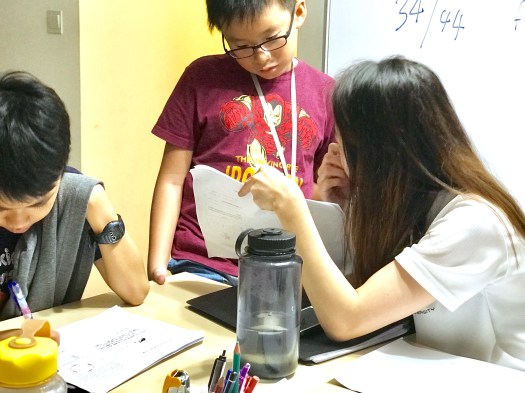
Punggol Female Tutors attending to Primary students when they find it difficult to understand
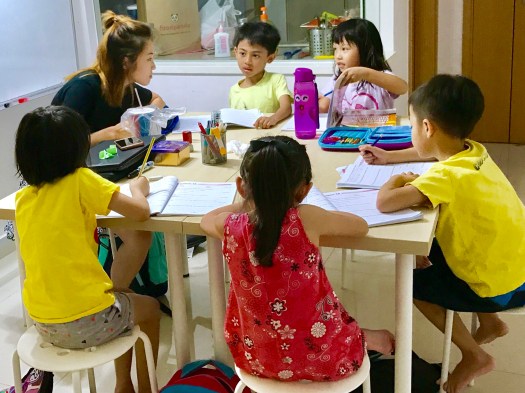
Punggol Tuition Centre for English Math and Science
Often have I heard parents complain about their child’s lack of reading story books. In Singapore, this is made worse with electronics like games and smartphones becoming a staple in everyday activities of our children. Texting and all that distraction becomes the scourge of the millennium to some parents. Made worse with social media and the need for kids to fit in with their peers.
So how do we change the tides and make the kids read?
reading as enjoyment
First and foremost, reading has to be enjoyable to our children. It has to be fun, and definitely a million miles away from being a chore. That is the key to starting them on the right path. So let’s see what we can do to make this fun.
information information information
Children are naturally inquisitive. They crave information of the world they are in. They are natural learners and if you can light the spark of curiosity, they will carry that spark and more often then not, you will not need to do anymore from then on. One way I create curiosity in my students are to tell them stories. Stories of great people like Julius Caeser and how he is forever remembered in our month July named after him. Stories of how our forefathers struggles lead us to where we are today. Make sure its fun, and something amazing and once you catch their attention, they will want to know more, after which, I print out relevant articles of that story, and they will start reading. With much curiosity.
The idea is to seed their imagination, and slowly they will latch on and take it upon themselves to find out more. And that’s where we welcome in the 21st Century. The internet is a fabulous playground for the child. Google their curiosity away and make technology you were lamenting turn to your favour.
Bear in mind, some stories works wonders to certain groups of students, some not so much. Which leads us to the next point.
customise your reading
Recognise that one man’s meat is another man’s poison. There is an art in tailoring materials that suits your child. More often than not, you probably know what your child likes. Every kid is unique, and what might work for one, will probably not work for another. Recognize that if you like Lord of the Rings, might not be what your child will naturally take after. Harry Potter perhaps, or even the great Classics.
Make sure they find it new and relevant, and something they don’t find old fashioned. Nothing stops them dead on their tracks faster than information that is irrelevant and old. Its like owning an old beat up car that you won’t want to show off to your friends. Information that is old makes kids feel like they are learning something that everyone else knows, pretty much like an old beat up car.
the story doesn’t stop there
Support your child’s interests by researching not just the topic itself, but everything else that surrounds the topic.
Transformers the movie comes along and you can start talking about Transformers. Wikipedia has articles about Transformers. Why? How? What? Who? Talk about Peter Cullen and how he got to voice Optimus Prime. Talk about your own experiences about Transformers in your childhood.
The innards and the stories surrounding a story makes it more interesting for your child. Its like a secret that no one else knows. Sssshhhh….. let me tell you something special… and they get all tingly because it makes them special.
be the pillar of knowledge
This is probably a good way to make a child read. Children usually learn more when they find a role model to emulate. Tell them things that we know. Our own stories, knowledge, and pass it on to them. When we tell them so much information, they will want to be exactly like us. And when they find out that we got our knowledge from reading, they will definitely want to do the same too. Birds of a feather, flocks together.
library vs bookshops
Again, technology is starting to be wide spread in this arena. Libraries are finding ways to keep up with the times and don’t forget Amazon’s kindle which is an electronic book. We can easily buy a book off the internet, or even download one of the many free ebooks that are available. iPads are starting to get into the act too with lots of free downloads. The thing is, do what your child likes. Bring your kids to the library, see if they like reading by borrowing books, or try to get down to a bookshop and let them have their fun browsing. Also, go to different libraries as some are swankier than the others. Like us, kids likes new places. And look good too doing it.
So there you go, it takes a bit of effort to start your child on the track. But once you unlock their potential, they will fuel their own passions. All we need is just to kickstart them onto the right path.
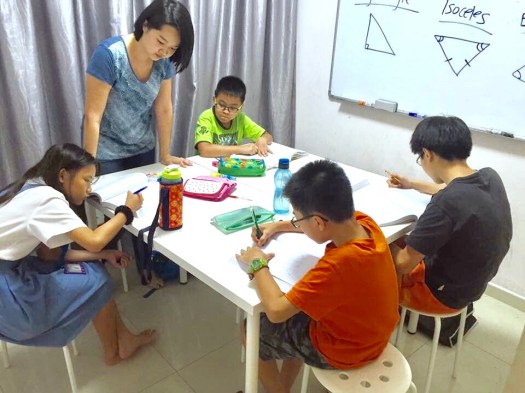
Making sure PSLE students knows how to do the full working for Paper 2 long questions.Primary Math Tuition for PSLEPunggol Small Group Tuition with female Punggol Tutor makes sure all students asks when they do not understandPunggol Tutor at eduKate SG Experience Best Female Tutors in Punggol for Small Group Tuition Primary 1,2,3,4,5,6 PSLE SEAB
PSLE. Primary School Leaving Examination are the first educational hurdle of all Singapore students and has been a staple of our enduring educational system since its inception. So what’s all the fuss over the PSLE’s? First and foremost, it dictates the secondary schools that a child can go to. Secondly, it dictates the stream that a child will be studying as well. The current secondary school streams are Express, Normal Academic and Normal Technical.
So how do you support your child in this endeavour?
I’ve been tutoring kids for the last 15 years and there are 4 main categories that characterizes a successful PSLE candidate.
Intelligence
Gumption
Stamina
Determination
Intelligence
Developing the intelligence of a child. What are the do’s and don’t’s? The first thing I find that a child do very well is the ability to acquire information. Their rate of learning is ferocious as compared to us adults. I always find that the weaker students has parent’s who underestimate the learning velocity and potential of their child. Quality of information, and the rate of disbursement of information to the child are important for the development of the intelligence of the child. Useless information leads to refuse in the brain. And a slow learning rate makes them lag behind their peers. Things parents need to avoid like the plaque. The PSLE score is heavily linked to the intelligence of a child. And rightfully so.
How do we develop the intelligence of a child?
The simplest and cheapest ways to teach a kid is to go to a library. Instill the virtues of the public library system. This old school method still has a few tricks up its sleeves and are still a viable way of acquiring superb materials. Enrol your kids in interactive courses organized by the library. They generally have reading classes for kids, or introduces new interesting books to make a bookworm out of your child. These classes also tend to involve socializing for your child, and that is an awesome by-product of making more friends and learning social skills.
Read to your child every night. By far, the most effective way of disbursement of information. Take 20 mins out of your hectic lifestyle. Pick any topic and start reading. Your child will learn diction, as well as gaining knowledge in the process. Therapeutic, and bonding with your child as the by-product which works in your favour far down the path of a healthy relationship with your child. What else can you ask for?
Games. I have always heard parents tell me that their kids play too much games and not studying enough. True enough. But I have to say, in moderation, games does provide an intelligence boost that cannot be acquired otherwise. Games can be divided into three distinct forms. Traditional board games, computer games and physical games like basketball. They all have their merits and again, used in moderation, gives an edge to children both mentally and physically. Games teaches kids a passion to persevere, to win or to lose gracefully, to solve problems, to improve hand-eye coordination, etc. The list is too long to talk about here but I think you get the picture.
IQ tests. These are the tests administered by MENSA. We don’t need to test our kids IQ, we just want them to acquire a love for solving IQ tests. Just like in the show “The Da Vinci Code” where Dan Brown weaves his tale out of codes and IQ type of quests, the mystery and intrigue can be intoxicating to your child. IQ questions tends to develop a heuristic skill that requires out of the box solutions. Again, we are living in a highly paced evolving society that requires this skill set to properly survive as we can never anticipate what will happen tomorrow. So, definitely a worthwhile skill to have for you child.
Music and the arts. I have never once thought that music nor the arts can be bad for anyone. Economically, it might be a challenge. But intellectually, it can be stimulating and promotes creativity. Singapore have invested heavily into the arts in recent years. New museums, galleries, art schools as well as a budding local arts community are starting to transpire our 20th century Singaporean hardwork into a 21st century First World culture. Take your child to an art museum, go for a musical, enrol in an arts class. Get the creative juices going and maybe find a hidden Michelangelo or Yo Yo Ma in our midst.
The News. How current is your child to the news? Current affairs are an important but often neglected development in a child’s scope of education. Ask your child what happened today and involve them in the latest developments of the world. In this decade, the internet has linked our lives into current affairs that we cannot let our child be ignorant in this topic. Twitter and facebook dictates so. Social networks are abuzz with the latest news and links people tighter than ever. If we don’t know what happened today, we are just simply a non-participant in the society. And that is where our child needs to be. To be a participant in our society and have a voice in this world. It is simply not enough to just exist anymore with our global connections.
New technology. Ever heard of first adopters? These are a bunch of people who live to buy the latest technology. It is obvious how techonology can help making your kid smarter. The latest technology always creates high interests in the minds of children. Since kids are pretty new to this earth, its only natural that they should get the latest. They also seem to get it faster than we do don’t they? As in, kids always seem to get a gadget running in no time, whereas adults takes forever. Now how do we switch this on again? Buying the latest technology and making it available for children to use creates a culture of always knowing what is the latest. Having the latest technology always creates winners, and don’t take my word for it, most wars are won by countries that have the latest technology of their times.
DIY. Do-It Yourself. How many times have you let your child do something and you not interfere? For example, get an order at McDonalds for the family? Sometimes, parent’s have a tendency to over-protect their children. You have all the right to, but draw a line to where that should stop. One day, your child will be a father/mother. How do we teach them to become one? By letting them do things on their own. And insist that they finish the job. But start them off slow and only on the right attitude. Don’t make them do things they don’t like. Dishes, laundry, taking the rubbish out. Or things that are dangerous. Boiling water, drilling, sharpening the knife are a definite no-no. That’s just counter-productive. Let them do things that make them feel like they are adults. Children loves to be mini-us, and takes pride when we approve of it and respects them as one. Let them order what they like, give them tasks that makes them excited. They might not do it well right off the bat, but hey, its their first time so give them some slack. They’ll get it right soon enough. And yes, they’ll turn out to be excellent parents because you showed them how to be one.
Disclaimer: The above can be applied to any child doing PSLE in Singapore. When I am talking about intelligence, I am not talking about gifted children whom are naturally intelligent. There are such kids but I have often been asked why some gifted kids don’t do well in the PSLE, and some do pretty well. I shall explain this later but the intelligence I am talking about are more generalized.
Meaning, any child who are capable of solving mathematical sums, understand scientific fundamentals and are capable of holding a conversation with their peers in a common language. This generally means almost 95% of PSLE participants will have the intelligence to pass the PSLE well. However, in the last 15 years being a tutor, I have seen these 95% and there are a wide varience in the ability to perform well due to external factors that are beyond their scope of intelligence. These variance can be due to parent’s educational background, the way they are brought up, their peers and simply, the schools that the child attend and the culture of their schools plus teachers and principals.
Gumption
Initiative and resourcefulness. These are the qualities that will create intelligence in a child. Students that show gumption generally do much better in their PSLE. Simply because they seem to find out more than their peers, as well as makes the best use of their time. Initiative creates students who study by themselves, find the relevant information by themselves and start their own studying when the need arises. Autonomy to operate before you tell them to do it. Resourcefulness on the other hand is to find what they need by themselves. Or make things happen with whatever resources they have. A real life MacGyver.
So how do we cultivate gumption in students?
We create a reason for them to start being serious with their studies. Prompt them of what they need to do. Give them a timeline of when they should start. I got a new Primary 5 student a year back. She had a bad mentality towards studies. When I asked her how come most of the question she did was wrong, she replied, “You mean I must get them all correct?” She did not care if she did well in her studies and had no idea what PSLE entailed. As far as she was concerned, computer games was her be-all-and-end-all. Then slowly, I slid in reasons why students should do well in PSLE during her classes. How a failure could mean a disastrous career in Singapore. And most importantly, what Primary 6 students do to get good grades in PSLE (meaning, 6-10 hrs of studies a day is a normal occurance) and when will they start preparing to do so much work. That was one year back. So its January now and she is still a student of mine. Guess what? She put her hand up the other day, and asked, “Can you print out more questions for me to do and I do it with my friend? And can I come over to ask questions if I don’t know how to do the sums?” And guess what? She did come back for extra lessons with me this week. Very encouraging indeed.
So what transpired? She woke up somewhere down the line last year and said to herself that she needed to do something about it. I am pretty sure she put a time she started to work harder. All I did, was to seed that thought that she needed to do something and a timeline of how it should be done. Very Inception indeed. But it worked. I don’t think there is a point in telling off children if they don’t study. They respond much better if they saw the need to do it themselves. The fire within will always burn hotter than the fire without.
Stamina
Stamina refers to the ability to put in the miles. Psst, the secret to awesome PSLE scores? 6-10 hours of pure studying. No complaints. No discomforts. Full focussing. So how does a child sit there relentlessly for the whole Primary 6 and knock in 10 hours of studying time? By starting them off young. The analogy to a marathon makes this easy. No one can run a full marathon without training and gaining stamina. This accumulation of stamina comes about by running 1km, increasing it to 2km, and then 3km, gaining higher endurance along the way, over months and years, and keep on moving the ante up till you hit the full monty. There’s is no other way of saying this but, for any child to do well in PSLE, they need to put the miles in. And the magical number is 10. 10 hours of studies every day. So start with 1-2 hrs during their Primary 5 holidays, then move it up to 3-4 hrs and keep on increasing this till it hits 10. Here’s a warning, don’t expect this to happen every day. Have some rest days and keep their mind fresh by doing something fun. They are afterall kids. They do much better if you start this regime earlier, during Primary 2-3. As with more practice and consistency, they tend to get better at keeping their energy high when they reach Primary 6 and need to clock in the hours.
Determination
All the above comes to naught without determination. The belief that it is possible to score high in PSLE is more important than everything that I have said so far. I have taught students that are very determined and some that aren’t. The first group tends to score higher, with all other factors being equal. Children tend to do well in things that they can believe in. They see a reason to aim higher. Nevermind if they don’t hit the mark, but aiming high at least gets them a better grade than one that aims low or worse, don’t have ant aim to begin with. So we have to be careful of the things that we say to them. Positive reassurances are a must. Its not good enough that we say it, we have to actually believe in it too. Optimism always trumps pessimism when it comes to studies.
So how do we instill determination in a child?
2 important skill sets has to be introduced to the child. A challenge. And the need to complete the challenge. Again, the methodology is much like the same as the stamina methodology. Start off with small challenges. But make sure the child does not give up. When they succeed, acknowledge them. If they fail, analyze the reason with them too. The important thing is not to give up till they suceed. Move up the ranks to harder challenges and soon enough, they will be determined enough to make sure they complete their own challenges.
In summary, the PSLE awards those who deserves it. With proper preparation and planning, it can be triumphed. I do believe all candidates can achieve a good PSLE grade. The reason for any divergence can only come from a lack of those qualities mentioned above. Of course, there are some factors beyond control, but I have seen students who started off wrong but finishing strong for the PSLE. Proper guidance and advice where it is needed is important to correct what is wrong.
What else?
We can help by making the environment conducive for the child to study in. A well lit, quiet and ventilated room. A properly organized study with all materials in easy reach. When every second counts in Primary 6, efficiency is everything. Keep a healthy diet and before you know it, the PSLE’s over.
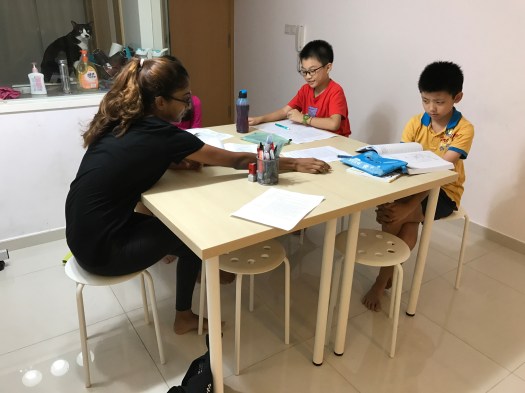
Our Punggol Tutor at eduKate SG Small tutorial classes for Primary School English, Math and Science tuition.Tutors marks students work and makes sure they are correct.
Punggol English Tuition Dunman High School IP Programme Singapore
So with the need in the 21st Century to be highly educated comes the need to provide an education that befits the dynamism of such an aim.
Society changes rapidly, with the industrial revolution going the way of the dinosaurs, the digital revolution maturing and now, the social revolution is upon us with Facebook, Twitter and forums gathering no moss with such an aggressive momentum onto our current lives. Everyone is a friend of someone now, and information travels around the globe faster than the blink of an eye.
Students are starting to mature in this age as well, incorporating digital elements early in life to be social individuals, exchanging thoughts and communicating with these tools. No longer are we surprised that our students approach us and know so much more than yesteryear. No longer are we surprised that they gulp information and understand the intricacies of the fabric of life.
So what do we do with such changes? It would be foolish not to keep up and make changes that would take advantage of these changes. Never sit still and let technology overcome us, and turn us into the relics that would make age gaps look ominous, outcast adults from their children and have our society alienate itself between the young and poor. This is where a page from United Nations website started looking very relevant to our lives, which I have included in this article as follows:
The following are an extract of an outline with regards to education as stated in United Nations website:
“The four pillars of learning are fundamental principles for reshaping education:
Learning to know: to provide the cognitive tools required to better comprehend the world and its complexities, and to provide an appropriate and adequate foundation for future learning.
Learning to do: to provide the skills that would enable individuals to effectively participate in the global economy and society.
Learning to be: to provide self analytical and social skills to enable individuals to develop to their fullest potential psycho-socially, affectively as well as physically, for a all-round ‘complete person.
Learning to live together: to expose individuals to the values implicit within human rights, democratic principles, intercultural understanding and respect and peace at all levels of society and human relationships to enable individuals and societies to live in peace and harmony.”
That is where we have to take note, to participate in the global economy and society, we have to keep ourselves not only mentally challenged, but physically fit as well. To keep upgrading ourselves to the new tools and skills, and never to stop changing ourselves, i.e to move with the times. Evaluation is the reset button of our lives. Re-evaluating our worth, our knowledge, and what new skills we need to keep ourselves relevant are the important points of what is written above.
So what are we doing at eduKate? We have never once stopped evaluating our skills and upgrading our techniques and tools. In 2014, there will be another suite of changes that will be implemented from Nov 2013 all through to Feb 2013. These comprises with a move to a new premise, new equipment for the students, and also new ways of teaching. Again, evaluation is the reset button we have, which means, we will move ahead with what works, and delete those that don’t, which was exactly what we have done in 2013. With positive outcome for our students and resulting with a group of positively happy parents.
Of course, the academics are not the be-all and end-all of a holistic education, which we are all too aware of. That is where we strive to keep our students well rounded and relevant, for the future is a constant question mark, and the best the students can do, is to be fleet footed and all ready for what is about to happen.








 Singapore Mathematics Tuition Centre