The Math Tutor for Small Group Tuition for PSLE, GCE O level IGCSE IB Diploma IP Programme Additional Maths for Primary and Secondary Levels. Top Singapore Tutor with two decades in education.
Classes for Secondary Mathematics (sec1 &sec2) E Math for IP Programme requires tutors to teach out of normal syllabus and requires a lot more work. However, we have experience over the years and make sure this class follows their IP requirements.
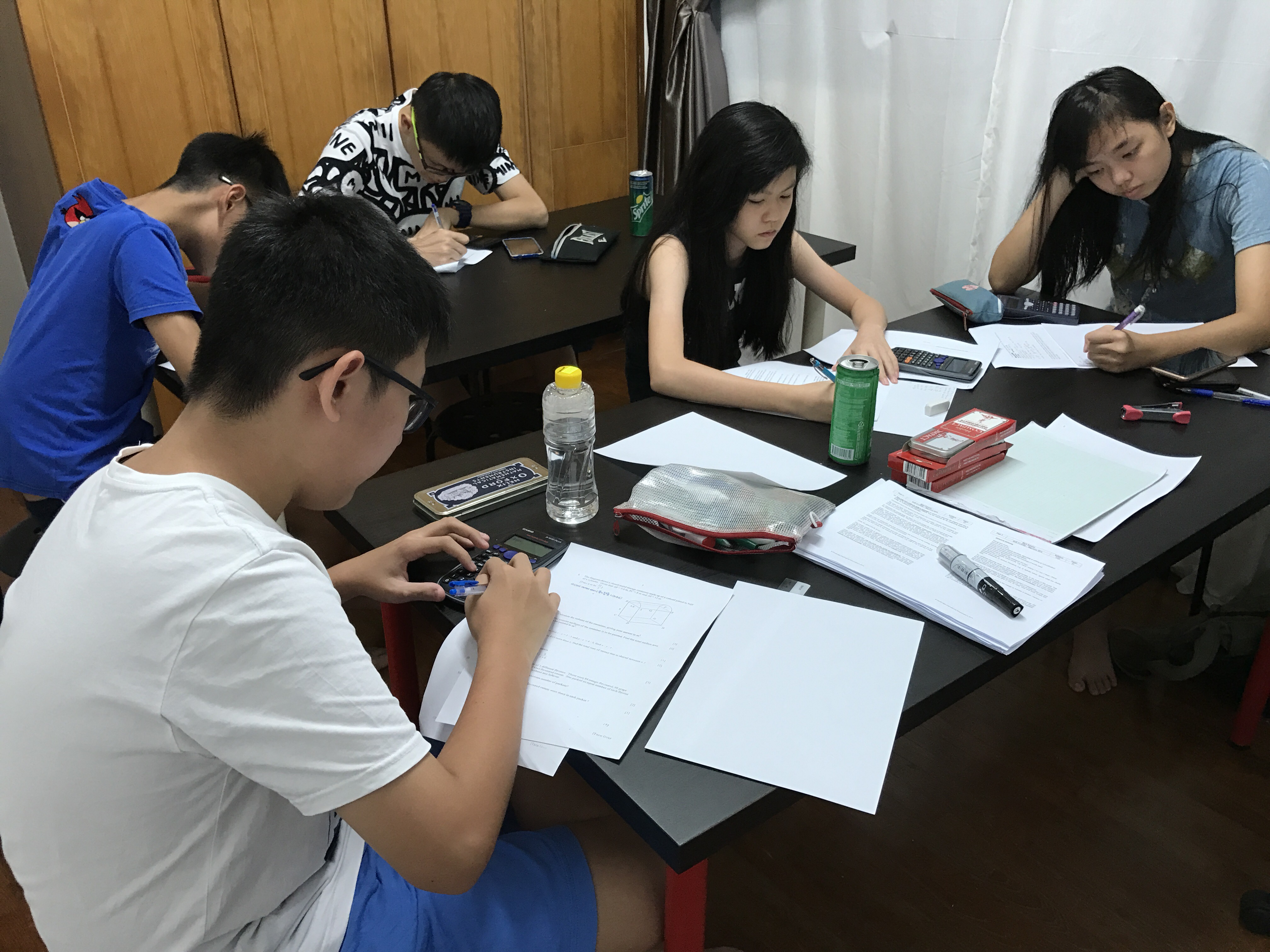
Today, this class goes through previous year exam papers and is training to obtain an A* grade for E Math.
IP Programme Math with Dunman High Student. SAP Student from Anglican High. A Math from St Hilda
Their requirements are speed, accuracy, and understanding how to manage their time, with extra time to recheck their paper to have no errors.
By now, September period) the students understand and have completed their syllabus being taught by Mr Wong well in advance. They do need to revise and make sure they go through all the permutations of the questions available, paying in particular their logical thinking processes and managing their stamina.
Call Yuet Ling +65 82226327 for our small group tuition.
Tutor Yuet Ling in the Office working on new materials. We customise all our classes for our students.Louis Vuitton, MBS, SGPCape Otway, Melbourne, Australia
NGV, Melbourne, AustraliaTutor Yuet Ling at LV MBS SGPTutor Yuet Ling at NVG Melbourne Van Gogh Exhibition 2017Great Ocean Road, Melbourne, AustraliaThe 12 Apostles, Great Ocean Road, Vic, AustraliaState Library, Melbourne AustraliaMelbourne CBD, AustraliaQueen Victoria Market, Melbourne CBD, Vic, AustraliaMelbourne CBD, AustraliaOur little local celebrity baby, Pebbles!Tutor Yuet Ling in Melbourne, Australia. Theatre going. PSLE English Vocabulary Small Group Tuition
Recently I came upon a conversation with Dr Sholpan about English language lessons for International students that are from non-English background, having classes with our students that are from Russia, Kazakhstan, China, Korea, Japan, Thailand, Nepal, Bhutan etc. We discussed and evaluated our classes for non-English speaking students that comes to Singapore to study in international schools.
The common language of English suddenly seems not so common after all for these students that study primarily in their own national language before they come over to Singapore and generally have a weak command of English. They are then faced with the prospect of learning their curriculum in a foreign language that they do not have full mastery over, creating a stress of learning a new language and also to do well in school.
They face the problems of subjects being taught in “alien” English, meeting new friends in a social English speaking environment and then get back to work on their schoolwork in English. Daunting tasks for anyone in a foreign land with a foreign language. We can only imagine what it feels like being alienated, but to actually socialise and study as well would make it monumental.
another successful session where Kazakhstan English students learns about Singapore’s education system
So how do we tackle the problems that these students face? This is what we do for our foreign students, and its been a lot of trial and errors, and we have been accumulating our experience with every new student and fine tuning our lessons to make sure they learn English in the fastest pace possible.
Their first problem will be to get as much friends as soon as possible. This is counter intuitive and not a lot of teachers will do this. The usual priority of almost all teachers are to get international students a formal start to English, i.e. grammar, sentence structure, subject-verb agreement, vocabulary, synthesis, comprehension/oral/composition exercises.
That is fine if we are trying to teach a primary school child that does not need to worry about heavy technical terms, no worries of getting to know new friends in a complex teenager environment as fast as possible, and no worries of having a conversation with teachers to get themselves as much help as possible.
So once they come for our classes, we don’t push them towards a “formal” English class format. We keep it simple, friendly, and useful. They learn English that they can use everyday, in every situation that they will find themselves in. Basically the solution that we advocate will be one that integrates them into the “English” speaking system as fast as possible.
Teach them English that is used in our common conversation. Words and phrases like a simple “Hi!”, “Thank you!”, “Can you please help me?”, “Sorry, but I don’t quite understand”, “How much is this?”, Where can I find this place?” etc. We never underestimate the usefulness of simple English. It is the most important start for anyone that does not communicate primarily in English.
We flew in from London for the week 2 English Class.
Useful phrases that they can use to get them further down the path to socially integrate them with their peers and colleagues plus get them more help from people that they meet. Keep everything informal and look at it from the perspective that they will learn more English from their friends and school, and our initial job is to kick start that process. The faster they can talk in English and make new friends in school, the faster they start learning English from their friends and teachers.
Currently, we can get them to do that in around 3-4 months of intensive classes. It is amazing how fast they can go from a miserly “Hello!”, to a full sentence of “Hi! We are studying Pythagoras’ Theorem in school and there is a test next week”. This happens by keeping things simple, useful, and relevant. They don’t need complex words or complex sythesized sentences strung together to impress the teachers, they need a conversation that they can understand straight off the bat and work from there. Learning from their friends, school, and community.
The next English class was full of top students and they love to know more of Singapore
Because they require a unique set of English lessons, we have to be creative, fine tuning every class and customise the lessons to the needs of each and every student and learn from our past experiences. We have to keep relevant, always, and as the students grow, we keep advancing them. Push them forward when they get too comfortable, and slow down when they feel too stressed. That is education. Adapt and equip them with skills and knowledge that will help them to thrive.
It is not the same for everyone, and we have to consider relevance too. What is relevant now, won’t be in the future. So we have to keep evaluating our classes to keep it up-to-date with current phrases, and keep on helping the students to make sure they do their best. That’s our job as educationists.
Tampines English Tuition PSLE IP IB GCE IGCSE SAP Tuition by Top RJC, ACJC, SAJC, TPJC Tutors
Top Score A1 for E Maths in Tampines and Marina Bay. Our ex-RJC/ACJC/SAJC/TPJC tutors teach E Maths Classes in accordance to MOE SEAB GCE O-levels, IP, IGCSE SAP syllabus requirements. We are currently following the new GCE O levels 2016 Mathematics Syllabus for EMaths.
Score A1 for E Maths
Class: Sec 3/4/5 Express and Normal(A)
Class size: 5-6
Class: full facility air con room
Class duration 1.5hrs
Materials: provided
Kindly call Yuet Ling +65 8222 6327 for schedules and course information.
IP Programme Math with Dunman High Student. SAP Student from Anglican High. A Math from St Hilda IGCSE GCE IP IB Secondary Mathematics GCE O levels at eduKate SG Tuition Centre GCE O Levels eduKate Singapore Tampines Tuition Centre Students in Tutorial Class 2
Secondary Mathematics Singapore Maths Tuition IP IB GCE IGCSE SAP Tuition by Top RJC, ACJC, SAJC, TPJC Tutors Tampines Marina Bay Punggol




 Singapore Mathematics Tuition Centre